


TL;DR
Problem: Most of us slowly overbuild our lives and projects: more routines, more apps, more offers, more “good ideas”, until even useful things turn into background stress. AI often makes this worse. Ask for a better morning routine or a plan to grow your small yoga business and it will happily give you something detailed, ambitious, and completely unrealistic for an ordinary week.
What this gives you: Via negativa is a simple mental model. Instead of asking “What else could I add?”, you start from what you already have and ask “What can I remove so this still works, but feels lighter?” This guide shows you how to simplify your life with AI by turning it into a subtraction engine: something that lays out your current week, routines, or ideas, highlights what actually matters, and suggests what you can safely remove, shrink, or postpone. By the end, you will have three copy-paste prompts you can drop into any AI chat to make one part of your life or work lighter in under 10 minutes, plus a tiny habit for using them regularly.
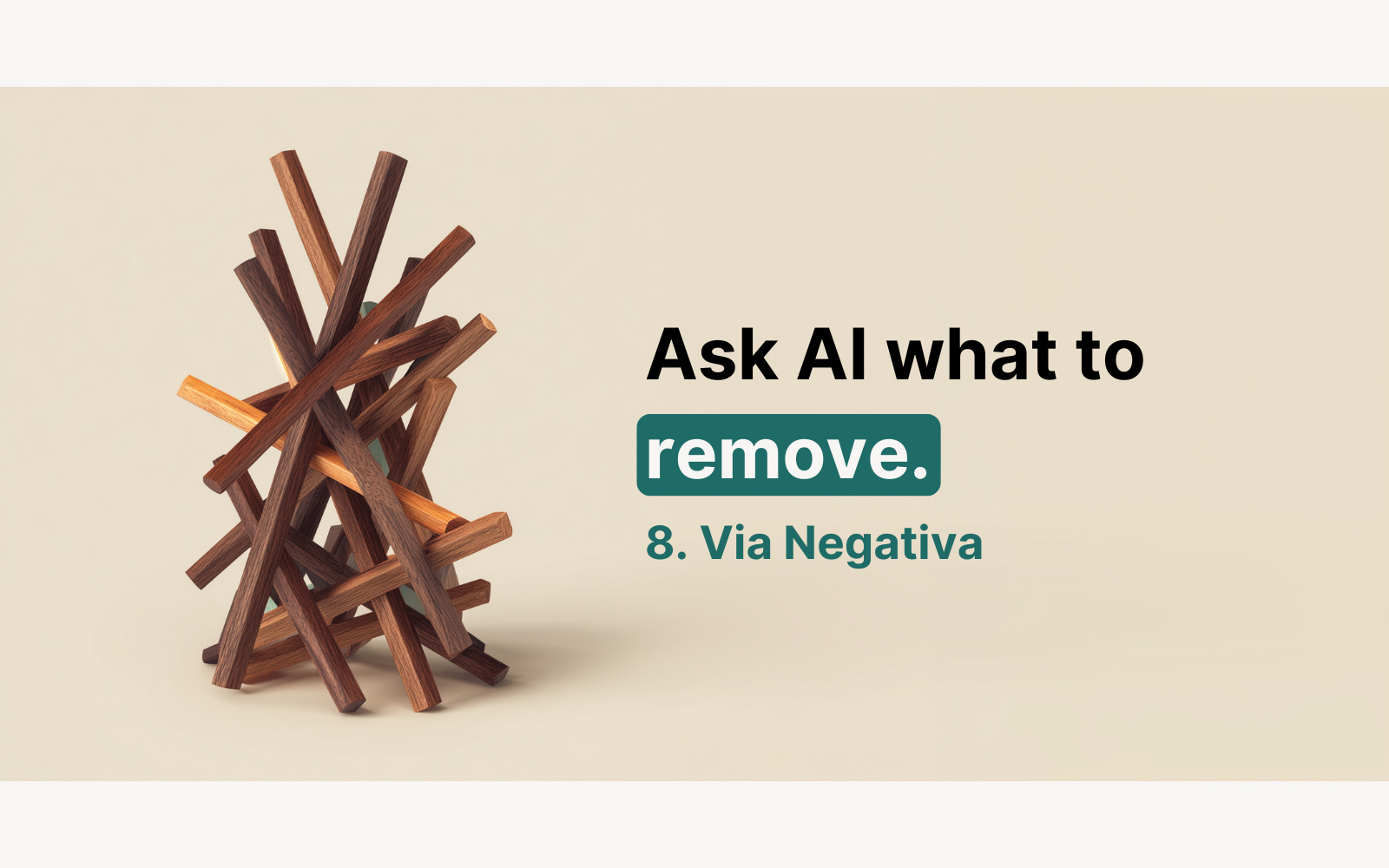
1. The Slow Creep of “Too Much”
There is a particular kind of tired that comes from having slightly too many good ideas in your life.
You do not crash. You do not burn out.
You just… drag a little.
Your morning routine used to be “wake up, stretch for five minutes, coffee”.
Then you saw a thread about the perfect morning and added journaling.
A podcast convinced you to add breathwork.
Someone mentioned cold showers.
AI helped you build a 12 step “optimal start to the day” with affirmations, mobility, planning, and three different apps.
None of these are stupid. Each one has a reason.
But now your mornings feel like you are clocking in for a shift instead of just starting your day.
The same thing happens with small projects and businesses.
You have a simple idea:
“I want to teach yoga and earn a bit of money from it.”
You open an AI assistant and ask for help.
It eagerly gives you:
A brand concept and colour palette
A content calendar for three social platforms
A website structure with blog, FAQ, and testimonials
Four pricing tiers
A plan for email marketing and a referral program
Again, nothing is wrong with any single piece.
But by the end of the conversation, “teach a few local yoga classes” has turned into “launch a fully fledged wellness brand”.
You still have not taught a single class.
You definitely have not made your first dollar.
But now you have a backlog of things you feel guilty for not doing.
One reasonable addition at a time, life drifts from simple and doable to busy and slightly unlivable. This guide is about using via negativa, together with AI, to quietly reverse that drift: to map what you already have, see what actually matters, and get concrete suggestions for what you can remove, shrink, or postpone without losing the result. In the next section, we will make via negativa itself very simple, then turn it into practical prompts you can run on your own life and small projects.
2. Via negativa in plain language
The classic idea of via negativa is:
Improve something by taking things away, not by adding more.
In everyday terms:
Start from the life or project you already have and ask:
“What can I remove so this still works, but feels lighter and easier?”
You are not trying to become a monk or win minimalist points.
You are trying to get closer to the minimum version that still does the job:
The simplest morning that still leaves you feeling okay about the day.
The simplest version of your yoga business that still pays you.
The simplest set of commitments that still makes your week feel like your week.
If you feel behind all the time, it is usually not a personal failure.
It is a sign the system around you is carrying more than it needs to.
Most of us flip this.
We ask “What else could I add?”
New apps, new exercises, new offers, new platforms.
Via negativa is the habit of pausing and asking first:
“Before I add anything, what could I quietly remove?”
AI fits into this in a very specific way.
It is extremely good at laying everything out on the table:
All the things you do in a week
All the steps in your routine
All the ideas you have for a small business
Once it has the map, you can ask it to be blunt:
Which parts look optional?
Which parts are doing the same job twice?
Which parts are heavy compared to the value they bring?
The model does not tell you how to live.
It just surfaces the cuts you could make, so you can decide.
When it helps
Use via negativa when:
Your day feels full but strangely unsatisfying.
You have a plan from AI that looks great on paper and impossible in real life.
You have a simple offer, like classes, lessons, sessions, buried under too many “nice to have” extras.
You keep saying “I do not have time”, but you never actually list what is filling the time.
In those cases, via negativa is a first pass with the eraser.
It does not redesign your whole life. It just asks, “What can we remove right now without breaking the point?”
When to be careful
Be careful with this lens when:
You are tempted to delete the one thing that genuinely helps because it is slightly effortful.
You are using “simplify” as a way to avoid doing anything at all.
The real problem is “I do not know what I want”, not “I have too much”.
You are in a situation where the direction itself is wrong and needs rethinking, not pruning.
Via negativa is not about refusing to grow or never adding anything new.
It just asks you to remove the unnecessary weight first, so whatever you do add has room to breathe.
Next, we will turn this into concrete AI prompts you can run on your own week, your routines, and simple “first dollar” business ideas.
3. Prompts to use via negativa with AI
The easiest way to use this mental model with AI is to literally say:
“Apply via negativa and help me see what I can remove.”
You describe a part of your life or work, add that one line, and let the assistant map things out and suggest what could go. Under the hood, all of these prompts follow the same pattern: List → Label → Lighten → Test. You list what is there, label what each thing is for, lighten the load by cutting or shrinking something, then test it for a week.
These are copy paste prompts. Save or screenshot them so you can reach for them the next time you want to simplify your life with AI, because your week, your routines, or your small business idea starts to feel heavier than it should.
3.1 Quick subtraction pass on your week
Use this when your week is full, you are always “busy”, but you are not sure what is actually worth it.
Apply via negativa to my week.
List my main recurring activities and what each is meant to give me (for example income, connection, learning, rest).
Mark the 3 to 5 that look least essential or could be merged with others.
Suggest 2 to 3 experiments where I remove, reduce, or bundle something for one week and tell me what to watch for to see if I actually miss it.
Here is roughly what a normal week looks like for me:
[describe your typical week: work hours, recurring calls, classes, chores, social things, side projects]
One week in, one lighter version of that week out.
If you try cutting something and nothing important breaks, it probably did not need to be there in the first place.
3.2 Trimming an overcomplicated routine or plan
Use this when you asked AI, or the internet, for a “better routine” and got something that looks great but you already know you will not follow on a tired day.
Apply via negativa to this routine.
Restate what this routine is trying to achieve in plain language.
Mark the few steps that probably create most of the benefit.
Build a ‘bare minimum’ version I could realistically do even on a busy, low energy day.
Put the remaining steps into an optional ‘good day’ version, not mandatory.
Here is the routine or plan:
[paste or describe your current morning routine, workout plan, study schedule, etc.]
You are not asking AI for a more impressive routine.
You are asking for the smallest version that still helps, plus extras you can add when you actually have the energy.
3.3 Turning a big small business idea into “first dollar this week”
Use this when you have a simple, human size idea, like:
Teaching yoga or pilates
Offering language or music lessons
Selling baked goods from your kitchen
Doing simple freelance work
and it has exploded into a full “brand” in your head.
Apply via negativa to this small business idea.
Summarize in one or two sentences what real value I want to give people.
Design the simplest possible offer I could realistically sell in the next 7 days (for example, one kind of class, one type of session, one product).
List everything else that can be safely postponed until after I have made my first dollar, and explain what I gain by not doing those things yet.
Here is my idea and everything I think I need to do:
[describe your idea, all the offers, platforms, branding tasks, content plans, etc.]
Instead of “launch a full wellness brand”, you end up with “offer this one yoga class at this time for this price to these people”.
You are not killing the bigger dream.
You are just clearing space for the first, small, real win.
4. Principles and traps
Now that you have the prompts, these rules help you make good cuts instead of accidentally deleting the wrong things.
A few rules keep via negativa sharp instead of turning it into “delete everything and hope”.
Principles
Name the non negotiable
“I want more quiet evenings.”
“I want my yoga classes to make money.”
Subtract around this, not through it.
Optimize for “easy to keep doing”
Choose the smallest version you can stick to on a bad day, not the impressive plan you will drop in a week.
Cut friction before joy
Drop draining admin and weak commitments before you touch the things that actually make you feel better.
Fewer, clearer offers
One obvious way to work with you beats five confusing options. Merge and simplify where you can.
Let AI be ruthless, you be kind
Ask AI to be blunt about what to cut. You decide what actually goes.
Traps
Deleting what helps because it is hard
If you always cut the gym, the walk, or the honest friend, you are dodging effort, not simplifying.
Minimalism as aesthetic, not function
Empty calendars and bare rooms are not the goal. A life that runs smoother is.
Using AI only to add
If every AI session ends with more tasks, you are missing the subtraction half of the tool.
Making permanent cuts instead of tests
Most changes can be “off for a week” first. If nothing breaks, then make it official.
Tidying the wrong path
If the whole direction feels wrong, pruning will not fix it. That is a job for rethinking, not trimming.
Used well, via negativa does not make your life tiny.
It makes enough space that the things you actually care about can breathe.
Next, we will look at how to turn these prompts into a small, repeatable habit instead of a one time cleanup.
5. From prompt to practice
So far you have the idea, the prompts, and some rules of thumb. The last step is turning this into a small, repeatable habit.
At first you will think of via negativa only after things feel too heavy.
Then you will remember it when you are already halfway through overbuilding something.
Later you will catch it earlier:
Before I add more, let me run a quick subtraction pass with AI.
The model for using this is simple.
Pick one small, real arena (your mornings, one day of your calendar, one routine AI gave you, or a single offer like a yoga class). Paste in one of the prompts from Section 3 with a bit of context and ask AI to apply via negativa. From its suggestions, pick one cut or reduction, cancel a recurring thing you will not miss, shrink a routine to a bare minimum version, or postpone an extra offer, and treat it as a one week experiment. After that week, check what changed: did anything important break, and did anything feel lighter, clearer, or easier to move forward? Keep the change if it helps, revert it if it does not.
You are not trying to design the perfect simple life.
You are just practicing one move:
Use AI to lay out what you are already doing, ask what you can remove, and make your systems lighter instead of heavier.
Most tools use AI to help you add more.
If you only remember one thing, make it this: ask AI what to remove before you ask it what to add.
This week, pick one small arena, run one prompt, make one cut, and notice what you do not miss.
Appendix: How this fits with First Principles and Occam’s Razor
This piece sits next to two other mental models you can also use with AI:
First Principles with AI
Use when you suspect the whole shape is wrong and you need to rethink from scratch.
You break a problem down to its fundamentals and rebuild from the ground up.
👉 Recommended reading: First Principles with AIFrom Prompts to Breakthroughs: The First-Principles Protocol for AI
·
The great trap of modern AI is the sheer plausibility of its answers. It can generate a logical five-point plan in seconds, yet the output often feels hollow. It’s a masterful summary of conventional wisdom, lacking any true spark of invention.
Occam’s Razor with AI
Use when you are drowning in assumptions and stories about how the world works.
You ask which assumptions you can drop, and notice which features or plans fall away with them.
👉 Recommended reading: Occam’s Razor with AIKeep It Simple, Stupid: A Guide to AI’s Occam’s Razor
·
TL;DR Occam’s Razor is a simple idea for finding the most direct path by challenging your assumptions. It used to be just for philosophers, but now AI makes it a practical tool you can use every day. This guide gives you a framework to cut through complexity
Via Negativa with AI (this article)
Use when you already have a working life, system, or small business idea and it just feels too heavy.
You keep the core and ask what you can remove, shrink, or postpone so it still works but is easier to carry.


A simple way to think about the trio:
First Principles: What is the minimum true structure if I started from zero?
Occam’s Razor: Which assumptions and stories can I safely drop?
Via Negativa: Given what I already have, what can I take away so this still works, but feels lighter?