


TL;DR
Occam’s Razor is a simple idea for finding the most direct path by challenging your assumptions. It used to be just for philosophers, but now AI makes it a practical tool you can use every day. This guide gives you a framework to cut through complexity, challenge your own thinking, and get focused.
1. The Illusion of Rigor
We all fall for the same lie: that a complex plan is a smart plan. A ten-step roadmap just feels more impressive than a two-step one. We’ve all been there, spending a week building a complicated dashboard when a five-minute chat with three customers would’ve given us the answer. This trap feels good because it creates a paper trail that looks like progress.
Used without discipline, AI is the ultimate amplifier of our bias for complexity.
It can generate beautiful, intricate, and deeply flawed plans in seconds. It lets us become masters of over-engineering, helping us build the wrong thing, faster and more beautifully than ever before.
2. The Power of “Fewer Assumptions”
The way out of this trap isn’t a better plan. It’s a better question: What is the simplest explanation that fits the facts?
This is the core of Occam’s Razor. It’s a simple rule for looking at ideas not by how complex they seem, but by how many unproven assumptions they rely on.
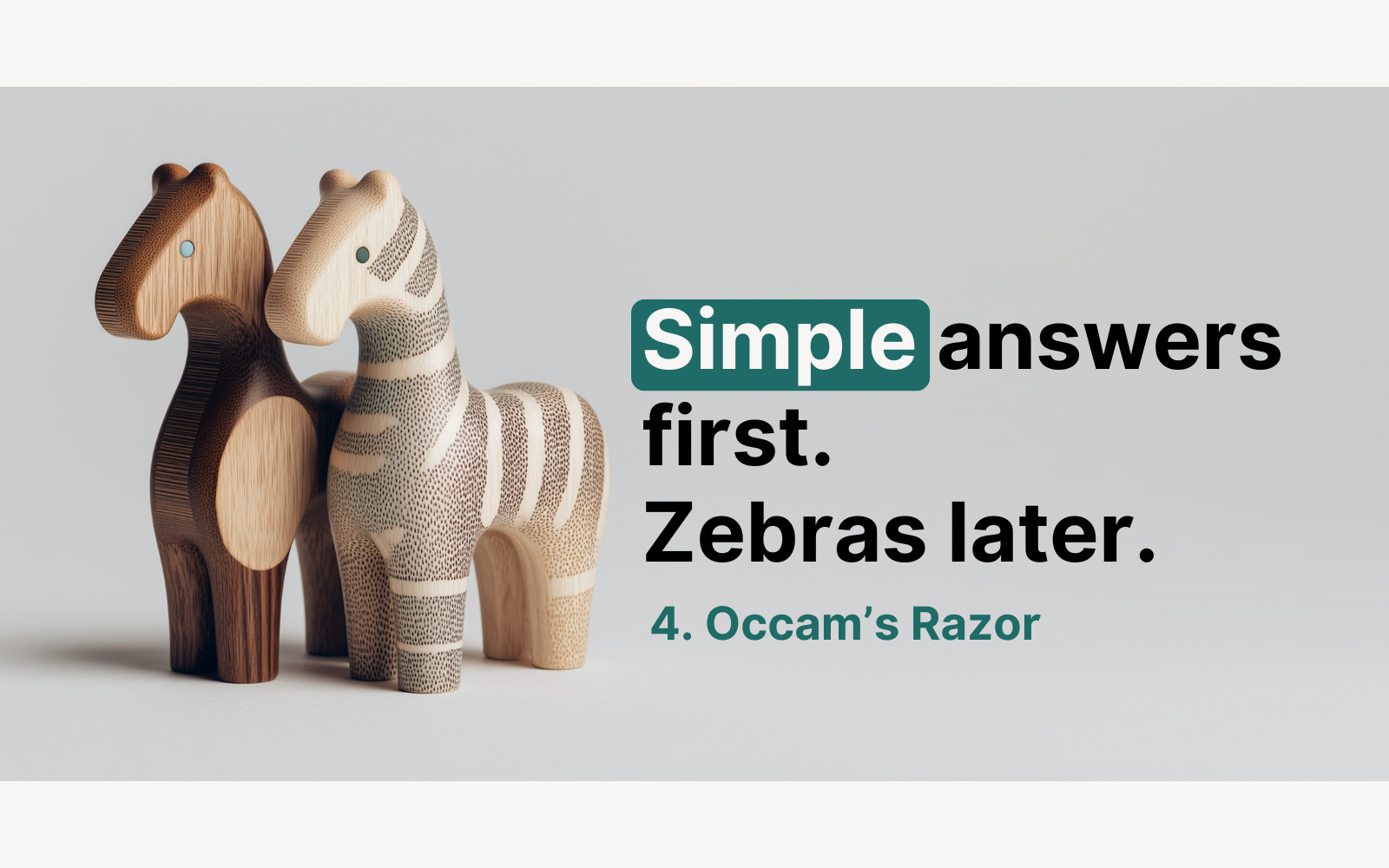
You’ve probably heard this in action from doctors: “When you hear hoofbeats, think horses, not zebras.” It’s a powerful reminder to always check for the simplest, most likely answer (the horse) before you waste time and money chasing a rare, complicated one (the zebra).
Today, pairing up with an AI gives us a powerful new way to separate facts from assumptions, turning this old philosophy into a practical tool you can use every day.
3. An AI-Augmented Framework for Applying Occam’s Razor
This framework turns a big idea into a real process you can run in minutes. The easiest way to start is to just describe your situation to an AI and add, ”...now let’s apply Occam’s Razor to this.” For a more structured approach, use these prompts.
The Assumption Audit (For Problem Diagnosis)
Use this to figure out what you know vs. what you just think you know.
Prompt: “Here’s my problem: [’Our user sign-ups have dropped 20% this month.’]. Analyze this. Create a table with two columns: ‘Facts’ (things we can prove with data) and ‘Assumptions’ (things I believe but haven’t proven).”
The Complexity Test (For Solution Design)
Use this to compare different options and find the most direct path.
Prompt: “We want to solve [Problem X]. We’re looking at two options: Plan A is [the complex solution] and Plan B is [the simple solution]. For each plan, list the core assumptions that have to be true for it to work. Tell me which one has fewer, easier assumptions to test.”
The ‘Do I Need This?’ Filter (For Personal Productivity)
Use this to stop over-engineering your own life and get back to basics.
Prompt: “My goal is [’to write more consistently’]. My plan is [’to build a complex Notion dashboard with calendars, a second brain, and reminders’]. Act like a coach using Occam’s Razor. What’s the one core assumption I’m making? And what’s the dead-simple action I could take to test it, without any of these tools?”
4. Occam’s Razor in Practice
To use this framework effectively, you must treat your AI partner as a sharp tool, not a source of truth. Its purpose is to enhance your thinking, not replace it.
The Principles
It Forces Intellectual Honesty. Occam’s Razor primary power is making the invisible visible. It forces you to draw a clear line between what you can prove and what you merely believe.
It Radically Saves Time. It helps you avoid the most expensive error in any project: building a robust and elegant solution on top of a single, unverified assumption.
It Creates Unwavering Focus. By methodically shaving away unnecessary complexity, the framework reveals the most direct path forward.
The Traps
Confusing “Simple” with “Simplistic.” The goal is not to be crude or to ignore reality. Occam’s razor cuts away unnecessary assumptions while respecting the ones that are truly required.
Weaponizing Simplicity. Be careful not to use the razor as a tool to reflexively dismiss new or ambitious ideas. Sometimes a new approach is simpler than the web of assumptions holding up the status quo.
Ignoring Complex Systems. In truly emergent systems, like an economy, the simplest explanation may be insufficient. The razor is a tool for starting an inquiry, not for shutting one down.
5. From Prompt to Instinct
At first, using the razor feels like a chore—a specific prompt you have to remember to run.
But after a while, you stop needing the prompt. It becomes the way you see the world. You stop seeing big, scary problems. Instead, you see a small core of facts and a bunch of assumptions you can question.
This changes everything. You start to value the speed and elegance of a simple solution more than the appearance of a complex one. It’s the foundation for building real-world systems, like our Two Gates model, that are built for clarity and speed.
The Two Gates: Build With Clarity and Conviction

Occam's Razor teaches you to shave away unproven assumptions. The Two Gates is the system we use to shave away unnecessary features.
6. Your Next Step: From Prompt to Process
Try this out today. Pick one of the prompts and run it on a real problem you’re stuck on. Taking five minutes to question one assumption is the first step to making this way of thinking an instinct.
P.S. We don’t just write about this stuff; we’re building the tool to run it. Segmnts is the platform we’re designing to make this entire system of focused work the default for your team. If you’re tired of trying to manage all this in docs and spreadsheets, join the waitlist for early access. What’s one assumption you’re running on right now that needs a gut check?
Thanks, your insights always cut thru. Like last time!