


Last year, a single strategic error cost me six months and nearly pushed me to burnout.
The vision was ambitious: a fully vertically integrated stack where I was the end-customer. The plan was to dedicate blocks of time to be the user—writing our company blog using our new voice-driven assistant, VoxProse—and then switch hats to be the builder, implementing the features I needed on the underlying Segmnts platform. On paper, it was a perfect dogfooding loop. In reality, it was a brutal lesson: no single layer was stable enough to support the next, and the entire structure crumbled.
While our previous articles have discussed Cognitive Dissonance Debt at the organizational level, this specific internal conflict for the builder deserves its own name: Product Dissonance. If you're a founder, product manager, or engineer who has ever felt trapped between the pressure to ship and the private, nagging knowledge that your product isn't ready, you've experienced it. It’s the root cause of the staggering 42% of developer time that is wasted fighting fires instead of creating value.

I fell into this trap for two reasons. First, I was diligently following the Silicon Valley gospel of "build in public" and "ship fast" without fully understanding its risks. More importantly, I was missing a simple mental model to guide my decisions. This article is about sharing that model—a framework that helps you escape the dissonance and start building with real conviction.
The Power and Peril of Building in Public
So how does a smart, ambitious strategy like vertical integration lead to burnout? It happens when that strategy collides with a powerful but misunderstood industry trend: building in public.
We see its power every day. Founders share product demos on social media, build trust through transparency, and create a powerful marketing funnel before they even have a sales team. For developers, seeing their work liked and shared provides an incredible morale boost. When done right, building in public is a formidable strategy for earning market credibility and validating ideas.
But it has a dangerous, dark side. The pressure for constant visibility can create a "Cult of Performative Motion," where the appearance of progress is prioritized over the reality of building a stable foundation. It’s the pressure to ship a splashy new feature for the weekly update, even when you know the core database is hanging on by a thread. The core product stays on the sidelines—unreliable and accumulating debt—while the focus is on shipping shiny new objects for the sake of a post or a demo.
Picture a founder, "Alex," who just raised a seed round. Their investors want to see velocity. So, every two weeks, their team demos a new AI-powered feature. The demos look great, but internally, the team is terrified. Each new feature is bolted onto a fragile core, and they spend nights patching bugs to keep the system from collapsing. Alex is deep in Product Dissonance: publicly projecting momentum while privately dreading the day the whole thing falls apart.
This isn't just a feeling; it's an economic disaster. This cycle creates a compounding fragility that becomes a significant driver of developer burnout—a condition that contributes to an estimated $300 billion annual cost in attrition and lost productivity.
The Two Gates Mental Model
Escaping this trap of wasted effort doesn't require more complexity or another heavyweight process. It requires a return to first principles, embodied in a simple but powerful mental model: The Two Gates.
The core insight is this: Product Dissonance comes from trying to pass both gates at once.
The model forces you to separate your work into two sequential jobs:
Gate #1: The Reliability Gate
The Question: "Can they use it?"
This gate is about stability, performance, and a bug-free execution. The first user you must satisfy is yourself. If you, the builder, don't have conviction that your product works reliably, you cannot proceed.
Gate #2: The Value Prop Gate
The Question: "Will they want to use it?"
This gate is about utility, desirability, and solving a real user problem for your target end-user. This is where you test if your reliable creation is actually useful.
The core principle is that these gates must be passed sequentially. You cannot get a clean signal on the value of your product (Gate #2) if your users are constantly fighting with its instability (Gate #1). This model is a practical application of industry-proven concepts like Marty Cagan's "Dual-Track Agile," simplified into a daily decision-making tool.
"But Shouldn't Value Come First?"
The most common pushback to this model is an immediate, intuitive reaction: "Shouldn't you figure out if people want something before you build it? Shouldn't Gate #2 come first?"
It's a logical question, but it hides a dangerous trap. When you prioritize validating a big, ambitious value proposition without any constraints, you remove the creative pressure that leads to smart, capital-efficient solutions. You give yourself permission to jump directly to the most expensive possible path: building the full "spaceship" because you're so convinced the destination is worthwhile.
The true power of the Two Gates model is that by putting Reliability first, it creates a generative constraint. It makes the default path—building the full feature—correctly feel prohibitively expensive. This forces you to ask a much better question:
"What is the cheapest, fastest, yet reliable way to get a signal on the value proposition?"
Let's make this concrete with the simplest possible example: bread.
Imagine you're in San Francisco and you have a hypothesis: people with gluten intolerance who can't eat local bread can enjoy bread from France without issues. This is your value proposition.
The "Value First" Path: You'd immediately try to solve the whole problem. You'd spend months and thousands of dollars trying to replicate French baking methods, sourcing new flour, and running test bakes, upsetting a lot of stomachs along the way. Your path to a signal is long and expensive.
The "Two Gates" Path: You start with Gate #1. You need a reliable way to get French bread to San Francisco. The answer isn't a bakery; it's a 747. You can outsource the reliability to an airline. You book a flight, buy a suitcase full of bread in Paris, and fly back. For the cost of a plane ticket, you have passed Gate #1 with near-100% certainty. Now you can focus entirely on Gate #2: you sell the bread to your target customers. Do they buy it? Do they enjoy it? You get a high-fidelity signal on your business idea in 48 hours, not six months.
This is the magic of the model. It forces you to creatively decouple the reliability of your product from the reliability of your experiment.
A Blueprint for Validation
The bread example shows how the Two Gates model forces creative, capital-efficient validation. This isn't a one-off trick; it's a universal blueprint for making smarter decisions at every level.
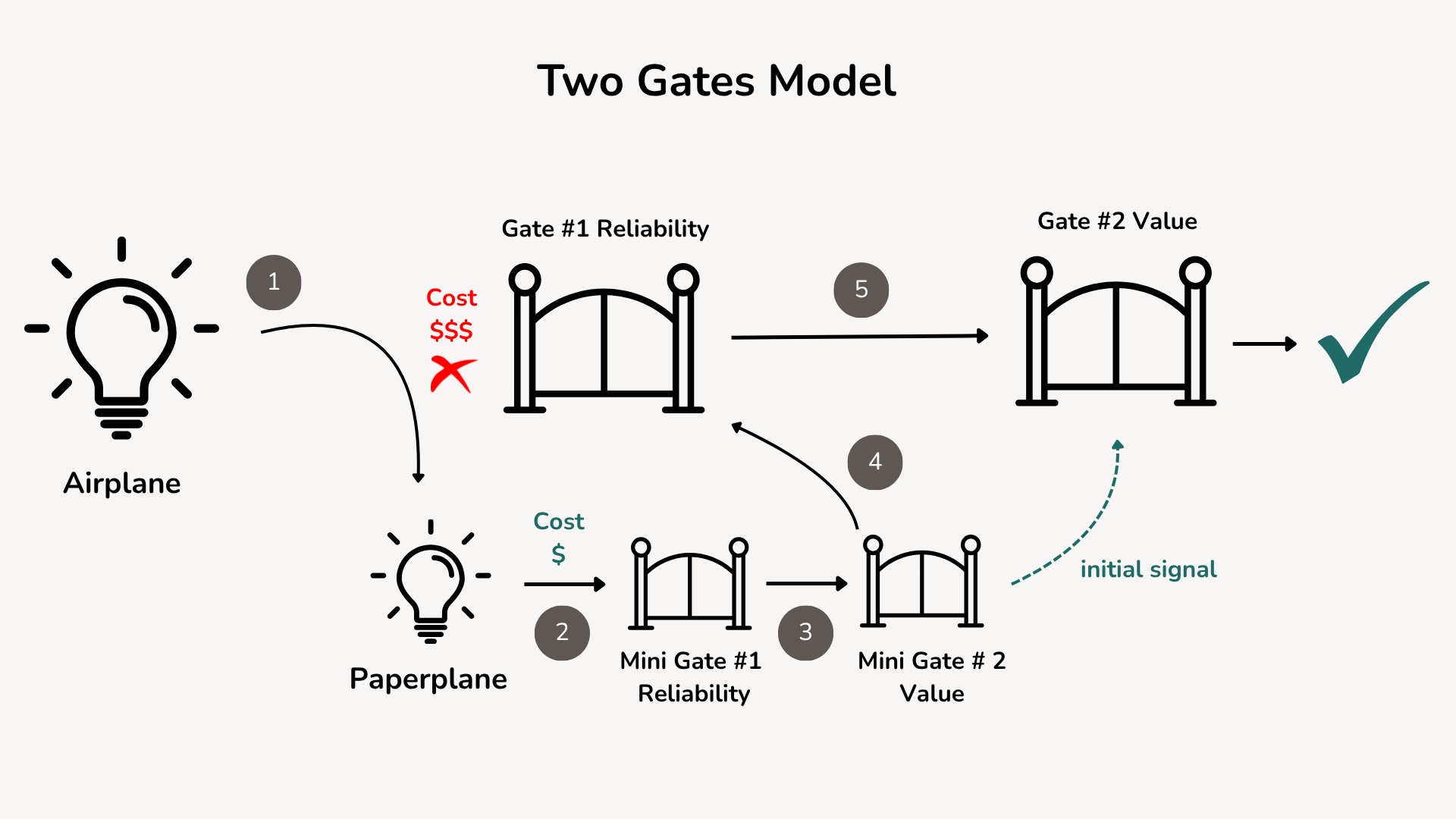
A Universal Model, from Vision to Feature
The legendary Dropbox MVP is the classic case study of this model in action.
The Big Vision: Build a seamless file-syncing service for the world.
The Prohibitively Expensive Path: Spend a year and millions of dollars building the full, high-reliability backend (passing Gate #1 for the service) only to find out if anyone wanted it (testing Gate #2).
The Two Gates Path: The team asked themselves our key question and found the answer wasn't a buggy prototype; it was a simple, 3-minute demo video.
Gate #1 (Reliability): The video had to be flawless as a video. It was a low-cost, high-reliability experiment.
Gate #2 (Value Prop): The overwhelming sign-up numbers were a massive "yes" signal for the value prop.
We recently applied this exact logic. Instead of spending weeks building our collaborative backlog features, we ran a "Wizard of Oz" simulation that took just 5 hours. The signal was amazing, validating our core hypothesis and reinforcing our mission to build these protocols directly into the Segmnts platform. We want to free up teams to focus on strategic work—like understanding the 'why' behind requirements—instead of clicking around in Kanban boards.
The Two Gates Toolkit
The Model: Sequentially pass Gate #1 (Reliability) then Gate #2 (Value Prop).
The Key Question: "What is the cheapest, fastest, yet reliable way to get a signal on the value proposition?"
The Method: Use low-cost validation (e.g., demo videos, concierge tests, Wizard of Oz simulations) to test Gate #2 before committing to a full build.
Building with Conviction and Capital Efficiency
The Two Gates model prevents the most expensive mistake a founder can make—building the wrong product perfectly. It achieves this by imposing a productive scarcity, forcing you to innovate your validation methods and be radically more capital-efficient. It’s the tactical tool that prevents strategic failures like the "Vertical Integration Trap" I fell into.
The Two Gates model is the 'why'. It's the mental framework for making the right strategic choice. But how do you execute on that choice every single day? For that, you need a tactical protocol.
In our next post on Friday, we'll share the 'how': our exact 3-question framework for defining work that respects the gates, The Deliverable Triad.
For now, I'll leave you with a simple experiment: The next time you define a new feature, run it through the Two Gates. Ask yourself:
"What is the cheapest, most reliable way I can get a signal on Gate #2 before I commit to a full Gate #1 build?"
P.S. We're not just writing about these protocols; we're building the tool to run them. Segmnts is the platform we're designing to make this entire system of building with conviction the default for your team. If you're tired of duct-taping this together in docs and spreadsheets, join the waitlist for early access.